Tuesday, March 29, 2016

Najib Razak 1MDB Scandal: Malaysian Prime Minister's Accounts Triggered Internal Money-Laundering Alarm

 So much money was pouring so rapidly into the Malaysian Prime Minister's personal bank accounts that it rang internal money-laundering alarms inside AmBank, a major Malaysian institution part-owned by Australia's ANZ.

Key points:
PM's personal account held under codename 'Mr X'
Account received more than $US1 billion in two years
Millions of dollars spent on luxury hotels, cars and jewellery

Hundreds of millions of dollars were being wired into Najib Razak's accounts from the Saudi Arabian Government, a mysterious Saudi prince and two shadowy British Virgin Island companies, while the head of a Malaysian state-owned company topped up the Prime Minister's credit card accounts with millions of Malaysian ringgit in cash.


Mr Najib's Platinum Mastercard and Platinum Visa had been overdrawn thanks to a 3,320,670.65 ringgit ($US1,039,369.91) purchase of jewellery in September 2014 — a spending spree described inside AmBank as a "huge volume".

Mr Najib's wife Rosmah Mansor has previously been reported to have purchased a series of luxury items, from diamond jewellery to designer handbags, which appear beyond her husband's $A130,000 official annual salary.


Between opening his account at AmBank on January 13, 2011 and April 10, 2013, Mr Najib received a total of more than $US1 billion — or, more precisely, $US1,050,795,451.58 — including a series of individual deposits that ranged between $US9 million and $US70 million.

Inside the bank, the Malaysian Prime Minister's account was held under the codename "Mr X".

The startling new banking records have been obtained as part of a Four Corners program that aired last night, and
which resulted in the arrest of two members of its team, Linton Besser and cameraman Louie Eroglu.

Watch last night's Four Corners: State of Fear


'Highly sensitive' report flags PM's unexplained wealth
The records also show that as well as spending some of the money on hotel accommodation and luxury cars, Mr Najib used the money to fund political affiliates in the run-up to Malaysia's last 2013 elections.

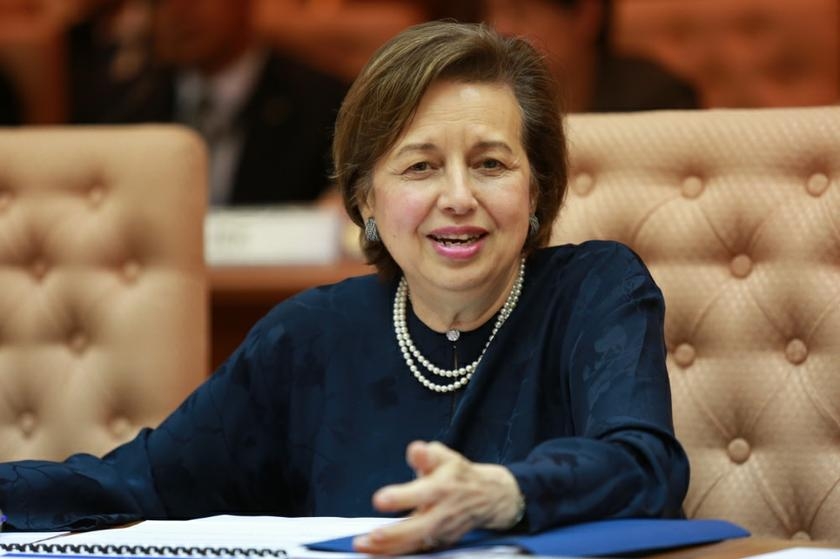
Four Corners has established that Dr Zeti Aziz, the governor of Bank Negara Malaysia, Malaysia's central bank, was repeatedly warned about the Prime Minister's unexplained wealth by senior officials at AmBank.
 
At one such meeting in September 2012, the ABC has been told Dr Aziz handed back the bank's report, which had been marked "highly sensitive", not wishing for Bank Negara to have a copy on its premises.

When the ABC asked Dr Aziz what action she took when she received these warnings, she said there were limitations on the scope of investigations that Bank Negara could itself conduct, but that it always reported information it received to relevant authorities.

In January, the Malaysian Attorney-General shuttered a corruption probe of the Prime Minister, declaring Mr Najib had no case to answer.

Despite this, Dr Aziz said there remained ongoing investigations.

Asked who was behind the money flowing into Mr Najib's accounts, Dr Aziz said: "I cannot comment on this, it is an ongoing investigation."

Do you know more about this story? Email
besser.linton@abc.net.au


'Absolute discretion' over use of 'Gift'
The remittances between 2011 and 2014 seen by Four Corners include payments by the Ministry of Finance in Saudi Arabia of $US49,999,988 on August 19, 2011, and $US29,999,988 on November 29, 2011.

There are also deposits recorded by AmBank as having come from a man named Prince Faisal bin Turkey bin Bandar Alsaud, of Riyadh.

These began on February 24, 2011, and continued into 2012 with $US49,999,965 deposited into Mr Najib's account on April 25, 2012, and another $US24,999,965 deposited on May 23, 2012.
Read the letter from HRH Prince Saud Abdulaziz Al-Saud to Prime Minister Najib Razak

These deposits were sometimes accompanied by letters to Mr Najib from a man described in the letter as "HRH Prince Saud Abdulaziz Al-Saud" which pledged gifts to the Malaysian Prime Minister which ranged from $US100 million on February 1, 2011, to $US800 million on March 1, 2013.

On November 2, 2011, for example, the letter pledged a grant of $US375 million, saying:

"This is merely a token gesture on my part but it is my way of contributing to the development of Islam to the world.

"You shall have absolute discretion to determine how the Gift shall be utilised.

"This letter is issued as a gesture of good faith and for clarification, I do not expect to receive any personal benefit whether directly or indirectly as a result of the Gift. The Gift should not in any event be construed as an act of corruption since this is against the practice of Islam and I personally do not encourage such practices in any manner whatsoever."

Multi-million-dollar 'donation' returned
There was another major source of funds to Mr Najib that has troubled investigators — a British Virgin Islands-incorporated entity called Blackstone Asia Real Estate Partners Ltd, which channelled its deposits via Standard Chartered Bank in Singapore.

The ultimate owner of the company has not been established, but it has been reported the company is associated with Low Taek Jho, known as Jho Low, a playboy financier at the centre of a highly controversial 2009 deal involving Malaysia's sovereign wealth fund, 1MDB.

Blackstone Asia Real Estate Partners paid Mr Najib $US69,999,988 on January 3, 2012, $US24,999,998 on March 13, 2012 and another $US24,999,988 on May 23, 2012.

Attempts to contact Mr Low were unsuccessful, but he has denied wrongdoing over the 1MDB deal.
 

It had previously been revealed by online news site Sarawak Report and the Wall Street Journal that a mystery BVI company called Tanore Finance deposited a total of $US680 million into Mr Najib's accounts in March 2013.

Two months ago Malaysian Attorney-General Mohamed Apandi Ali said $US620 million of this money was a "donation" that had subsequently been returned.

Now the new banking records show Mr Najib also received 4.3 million ringgit in cash top-ups that set off money-laundering alarms inside AmBank.

These were deposited by Nik Faisal Bin Ariff Kamil, the former investment director of 1MDB and chief executive of state-owned company SRC International. The files show he was a signatory to the Prime Minister's account.

In January 2014 he wrote an apologetic letter to an AmBank manager to explain why he had to so hurriedly deposit large volumes of cash into the account, explaining that "there will be occasions when I won't be able to provide necessary transfer authorisations to the account".

Large sums spent on holidays, cars
SRC International has been in the spotlight since it emerged it made a 27 million ringgit payment that also ended up in the personal accounts of Mr Najib.

That payment formed the basis for a criminal charge that was going to be laid against Mr Najib midway through last year, but which was aborted after the Attorney-General was suddenly removed from office.

The bank records also detail how Mr Najib used his new-found wealth. Much of it went to political affiliates in the lead up to Malaysia's last election in May 2013, including party officials, the Liberal Democratic Party and the Sarawak United People's Party, as well as various advertising and media firms.

A company called Solar Shine Sdn Bhd received the largest distribution — 24 million ringgit or $US3.5 million today.

The company has been associated with an entity called 1Malaysia NGO which has run grassroots political campaigns on behalf of Barisan Nasional, the Prime Minister's party.

A sum of 7.5 million ringgit or $US1.9 million went to the Rahah Foundation, which hit the headlines in Malaysia when it donated cows alongside Mr Najib to the Selangor police to be sacrificed for Eid al-Adha, a Muslim ritual feast celebrated each year.

But there are other payments too that may not have had a political purpose.

These include 360,000 ringgit spent with fashion house Jakel Trading, 395,782.40 ringgit at the Shangri-la Hotel Kuala Lumpur, 178,000 ringgit spent with a company called Two One Holidays Malaysia and another 167,959.50 ringgit with Signature Exotic Cars, a dealer that specialises in Audi, Mercedes Benz and Porsche.

The files show Mr Najib directed cheques also to prominent businesspeople, academics and lawyers.

The Malaysian Prime Minister did not respond to written questions from Four Corners.
 
Sources from:

Friday, September 11, 2015

HOW SIRUL BLACKMAILED NAJIB! - World Media Spotlight Now Moves To The Altantuya Case

Shocking new evidence has emerged over Malaysia’s most notorious murder case, with the airing of an explosive documentary about the death of Mongolian model Altantuya Shaariibuu at the hands of the Prime Minister’s bodyguards on the world news channel Al Jazeera’s 101 East programme today.
 
The gripping and closely documented report by the veteran Australian reporter Mary Ann Jolly contains allegations that the man who shot Altantuya was none other than her ex-lover Razak Baginda, a close aid of Najib Razak, who earlier this year alluded to “rogue cops” being engaged in a motiveless murder.
 
 
Even more astonishing are text messages retrieved by Al Jazeera from the mobile phone of Sirul Azhar Umar, the man convicted of the killing, which show the convicted bodyguard was blackmailing Prime Minister Najib Razak for millions of dollars to stay in Australia and “say nothing” about the case just before he was re-arrested.
 
This way, said Sirul, “I won’t bring down the PM”!
 
Tellingly, the response from Najib’s intermediary Abdul Salam bin Ahmed was that Sirul’s demand for a total of AUS$17 million was “being discussed”.  Salem has regularly visited Sirul, who is being held at the Villawood detention centre in Sydney and is believed to be involved in funding his legal team in Australia.

"I want 15 million and I won't return to Malaysia ever. I won't bring down the PM"
“I want 15 million and I won’t return to Malaysia ever. I won’t bring down the PM”

Baginda “pulled the trigger”!

According to the programme Sirul confided to an Australian relative that the person who had shot Altantuya was none other than the former boyfriend, whom she had been trying to blackmail, Razak Baginda.
 
The relative who was interviewed, but did not want to be identified told Mary Ann Jolly:
“I said, did you pull the trigger?  He said, no I didn’t pull the trigger, Razak pulled the trigger”
Salam's response was "they want to discuss"
Salam’s response was “they want to discuss”

Baginda, who was Najib’s personal negotiator for the Scorpene Submarine deal with France was never put on trial or questioned as a witness for the murder, despite being on record as having contacted Najib’s bodyguards to help him deal with the harassment from his former lover.

Baginda blamed "rogue cops" but Sirul says it was he who pulled the trigger
Baginda blamed “rogue cops” but Sirul says it was he who pulled the trigger

According to Sirul, his relative said, there were three at the murder scene. Baginda had shot Altantuya, but the two bodyguards had been tasked to then destroy the corpse with explosives.
 
In January Baginda had told a press conference that the case was an example of “rogue cops” and denied there was any further need to establish motive for the killing of his ex-girlfriend who was blackmailing him with her knowledge about kickbacks on a major defence deal.
“He [Sirul] told me he went back and he blew the body to pieces.  I said “you had a choice of walking away from the situation and leaving it alone” – and he said “I would have been dead” because of what he knew” [said Sirul’s relative]
There will now be international pressure to re-open the case where a key witness is now incarcerated in an independent third party state with a strong legal system.
 
The conduct of the original trial, which was heavily criticised by judges in Malaysia’s own Court of Appeal last year, will inevitably be found wanting, threatening another embarassment for Malaysia related to another Najib cover-up.

Najib had been Altantuya’s lover also

The programme also confirms that there was testimony by the key witness Bala that it was Najib Razak who had originally been the lover of Altantuya and that he had passed her on to Baginda during the course of the Scorpene deal, which has been the centre of a court investigation in France over hundreds of millions of ringgit paid  in kickbacks to companies controlled by Baginda.
 
Baginda was managing the deal to build three submarines with French contractors as a ‘personal envoy’ for Najib while he was Defence  Minister (in the same way that  Jho Low later acted as Najib’s proxy in the board room of 1MDB).
 
Programme says Najib had introduced Altantuya to Baginda at a diamond exhibition in Singapore....where Rosmah was presumably shopping
Programme says Najib had introduced Altantuya to Baginda at a diamond exhibition in Singapore….where Rosmah was presumably shopping
 
Najib has denied knowing Altantuya, but the film details contradictory evidence and analyses the entire cover up of the shocking murder case through a heavily manipulated trial, which refused to permit examination of why Najib’s bodyguards abducted Altantuya outside Baginda’s house and who ordered them to kill a woman they did not know.
 
There is a rare interview with the widow of the key witness PI Bala, who details how her husband was threatened and bribed to change his initial statutory declaration about the crime by none other than Najib’s own brother.  The couple were bundled into hiding abroad.
 
Najib told reporters that Bala's evidence was untrue, at the same time the witness was being threatened to change his story and leave the country
Najib told reporters that Bala’s evidence was untrue, at the same time the witness was being threatened to change his story and leave the country
 
The dramatised documentary, which contains chilling scenes, also features the father of Altantuya, who is now launching a civil case over the death of his daughter. He describes how he is fearful himself to return to KL.
 
The long belated televising of such a blatant cover up of murder orchestrated around a senior political figure threatens to globalise a case that for years has been kept firmly under wraps by the powers that be in Malaysia.
 
What motive? The two bodyguards who took all the blame
What motive? Najib’s two elite bodyguards who took all the blame
 
Reporter Mary-Ann Jolly is filmed being thrown out of the country when she arrived at Kuala Lumpur airport in an attempt to interview the Prime Minister about the extensive evidence collected by the programme.
 
You can watch the half hour documentary that has brought yet another skeleton crashing out of the Prime Minister’s closet – this time it is the fragmented body of Altantuya Shaariibuu.
 
Grand theft is one thing for a politician to find himself uncomfortably more than close to, murder is quite another.
 

Friday, June 12, 2015

The World’s Worst Investment Bubble Will Burst Soon


Investment bubbles always look so obvious in hindsight. But when you’re in the middle of one, it’s hard to fight the crowd, even if that little voice in your head tells you to run for the hills.

Why? Bubbles produce compelling narratives that give people reasons to believe. The Internet is changing everything. Housing prices never go down. Tulips are the most precious commodity on God’s green Earth, etc.

Now the same thing is happening again in China, a market that has had one huge bubble burst only recently. The Shanghai Composite index briefly topped 6,000 in October 2007 only to plummet to just above 1,700, a sickening 70% plunge in only 12 months.


But a mere seven years later, Shanghai is above 5,000 again, and the bulls say more gains lie ahead, even though China’s economy is slowing dramatically and some valuations already are stratospheric.

They’re counting on China’s central bank to keep cutting rates. It already has
reduced them three times in the past six months. Sound familiar?

Also, the Chinese government has eased trading restrictions on foreign investors. On Tuesday, index provider MSCI said it “
expects to include China A shares in its global benchmarks” once it works out some issues with Chinese regulators. A flood of institutional money would presumably follow.

Indeed, mutual fund company Vanguard said last week it would gradually increase the number of mainland China-traded A shares in its Emerging Markets Stock Index Fund 
and ETF.

This macro “story” has powered Shanghai 150% higher in the past 12 months. Shenzhen and other mainland markets with riskier, more speculative stocks have nearly tripled.

With the animal spirits unleashed, average Chinese investors are piling in. In a reverse of what happened in the U.S. in the 2000s, Chinese investors fleeing a busted housing market have thrown their money into stocks. Talk about going from the wok to the fire!

Consider these worrisome signs:

• China’s GDP growth slowed to 7% in the first quarter, the slowest since the Great Recession, and that figure
may be overstated by 1 to 2 percentage points, according to Capital Economics.

• Analysts project earnings growth of companies listed on Shanghai and Shenzhen will be 7% in 2015, the
lowest in three years, Reuters reported. The biggest culprits: banks grappling with a surfeit of bad loans.

• ChiNext, an exchange focused on startups, is trading at 140 times last year’s earnings, “
in the same league as Nasdaq … at the height of the dotcom frenzy,” The Economist wrote.

• According to one estimate, nearly 85% of China-listed companies are trading at higher multiples today than they did at the previous top in 2007.

• Margin debt is skyrocketing, up more than fivefold in a year to around 2 trillion yuan (about $320 billion), an “unprecedented” 8.9% of the market capitalization of the Shanghai and Shenzhen exchanges. “This could already be the
highest level of margins vs. free float in market history,” wrote Macquarie, and perhaps the fastest increase in margin debt we’ve ever seen.


• From January 2014 through mid-May,
225 IPOs came to market on China’s A-share markets, with a mean price appreciation of 418% and trailing-12-month price-to-earnings ratio of 92, according to Morgan Stanley.

• In the four weeks after the government allowed investors to have more than one trading account, individuals opened 12.8 million new accounts. Chinese retail investors generate
90% of all trades, reports Barron’s, higher than the historical average of 80%.

Unfortunately, Chinese investors don’t seem to have learned from their mistakes in the last bubble, maybe because they’re not the same people. And the newbies are hardly sophisticated investors: The Economist cited a study that said more than two-thirds of them left school before the age of 15.

Meanwhile, the so-called “smart money” is cashing in its chips: Both Morgan Stanley and BNP Paribas recently turned bearish on Chinese stocks.

Jonathan Garner, Morgan Stanley’s chief Asia and emerging markets strategist,
downgraded China stocks for the first time in more than seven years, citing “the weakest corporate profits since 2009.” “We’d like to recommend taking some profits,” he told Bloomberg.

I’d put it even more strongly. Back in October 2007, I called China’s stock bubble the
Mother of All Manias and wrote:

“… Some day, as sure as the sun rises in the East every morning, this market will come crashing down around our ears.

“… Too many novices are engaging in what looks much more like gambling and speculation than long-term investing ...

“Trust me, this can’t last — it never has. The only question is when it will end.”

I stand by those words today. If you’ve had the dumb luck — and don’t kid yourself that it’s anything else — to have made money in the latest China stock mania, I have five words of advice:
Get. The. Hell. Out. Now.
 

Sunday, June 7, 2015

Jho Low Used US$260 Million 1MDB Cash To Take Over UBG.

The Edge Weekly has published an exposé on how businessman Low Taek Jho, or Jho Low, had in 2010 used US$260 million of 1Malaysia Development Bhd's (1MDB) cash to do a take over of UBG Bhd.


In its latest issue, the business weekly said Low was helped by executives of 1Malaysia Development Bhd (1MDB) and PetroSaudi International and it published emails between them as proof of the scheming.


The Edge said that at the time Low surreptitiously made the general offer for UBG via Javace Sdn Bhd, he already owned a substantial stake in UBG through Masterpiece Sdn Bhd.

He never disclosed that he was the offeror of the takeover which is a breach of securities law.

The weekly also said that Low was able to hide his involvement in the takeover through the help of the PetroSaudi group and The Edge also showed emails between Low and executives at 1MDB and PetroSaudi as proof of complicity.


UBG was the financial vehicle of then Sarawak chief minister Tun Taib Abdul Mahmud but it sold RHB Bank in 2007 and was left with nearly RM2 billion cash which was what attracted Low to first buy into the company. – The Edge Weekly, June 7, 2015.

Refer here to understand more what is really happen!!!

http://www.scribd.com/doc/267868806/Mm-F1t4-1mdb-1070-new

Thursday, June 4, 2015

Statement On 1MDB from Bank Negara Malaysia

As the nation's Central Bank, Bank Negara Malaysia is entrusted to promote the stability and integrity of the financial system and the sustainability of our economy. Widespread news reports and commentaries regarding 1MDB have raised questions on whether the Central Bank has continued to uphold the trust that has been placed on the Bank.


The purpose of this statement is to provide clarity on the role of the Central Bank with respect to any resident entity, including 1MDB, that makes investments abroad or obtains offshore borrowings under Section 214 of the Financial Services Act 2013 and under the Exchange Control Act 1953 that was in force prior to 2013. All investments that exceed RM50 million per calendar year and any offshore borrowings that exceed RM100 million by resident entities require the Central Bank's approval. 

In relation to this, all submissions that were made by 1MDB have had to comply with the same approval criteria that is applied to submissions by other business entities. If the criteria is not met, the submission will be rejected. No leniency or special exceptions were accorded to 1MDB.


In accordance with the legislation administered by the Bank, the following developments will trigger formal investigations:
i) When monies for which approvals are given are not used for the purpose indicated in the submission;
ii) When incorrect or false information are provided in the submission; and
iii) Failure to comply with the conditions in the approval.

As part of an investigation process, the Bank will issue a legal directive requiring information pursuant to the relevant Acts that the Central Bank administers. This will require the Board and Management of the entity to provide the information within a specified time frame. Under the Financial Services Act 2013, the penalty for failure to meet this request can result in a fine of up to RM50 million or up to 10 years in prison or both.

In relation to cross border movements of funds, the Bank also relies on financial intelligence authorities in the foreign jurisdictions to bring to our attention irregular or suspicious transactions made in their jurisdiction. Such arrangements for information sharing must conform to international protocols. 

The arrangements require that the information be kept confidential and any breach will lead to the termination of such arrangements. These arrangements also provide for the Bank to share the information with relevant domestic investigation authorities after securing the permission of the foreign authorities.


The scope provided under the Central Bank's legislation does not provide powers for the Central Bank to investigate in areas such as fraud, tax evasion, corruption, cheating and criminal breach of trust. These will need to be pursued by other law enforcement agencies.

With respect to 1MDB, a formal enquiry has commenced to examine any contravention of the Central Bank's rules and legislation. This has involved the issuance of a legal directive requiring information from the entity. 

The Central Bank is also taking statements from individuals involved in the governance process and obtaining information from other relevant domestic and foreign parties. In addition, Bank Negara Malaysia has forwarded information received from foreign authorities to the relevant investigation agencies after obtaining the permission from the foreign authorities.

The Central Bank wishes to emphasise that further disclosure of details of the investigation may undermine the outcome of the investigation. The Central Bank is doing everything within the powers provided under its legislation, including collaborating with other agencies, to contribute towards a swift resolution of the matter.

Bank Negara Malaysia
03 June 2015

© Bank Negara Malaysia, 2015. All rights reserved.

Monday, June 1, 2015

Stick With Me On 1MDB or Resign, Najib Tells Ministers

KUALA LUMPUR — Malaysia Prime Minister Najib Razak is said to have issued an ultimatum to his Cabinet last Friday (May 29), telling ministers to resign if they did not support him over the rehabilitation of debt-ridden state fund 1Malaysia Development Bhd (1MDB), Utusan Malaysia reported today (June 1).

The UMNO mouthpiece said, according to a source, none of the ministers declared he or she would not support the prime minister on 1MDB.


Mr Najib was said to have issued the ultimatum soon after Finance Minister II Ahmad Husni Hanadzlah finished laying out the road map for 1MDB’s restructuring to the ministers.

“The prime minister told members of his Cabinet who were not with him on the 1MDB issue to resign, but not one person did so,” the source told the Malay daily.

Utusan also noted that Mr Najib’s ultimatum followed the statement by Barisan Backbenchers Club chairman Shahrir Samad, who last Tuesday (May 26) urged ministers, who did not agree with the collective decision of the Cabinet on 1MDB, to resign.

Mr Shahrir was expressing his agreement with UMNO’s Gua Musang MP Tengku Razaleigh Hamzah, who said the entire cabinet was collectively responsible for 1MDB’s controversies which have sapped public confidence over the government’s handling and transparency over the Finance Ministry-owned firm with debts of RM42 billion (S$15.5 billion).

Mr Husni, who has been made the government’s spokesperson on 1MDB, had said the company had entered into a binding agreement with Abu Dhabi’s International Petroleum Investment Company (IPIC) and its subsidiary, Aabar Investments (Aabar), where IPIC would pay 1MDB US$1 billion (S$1.35 billion), on or before June 4 this year.

The US$1 billion payment would be used to repay a US$975 million loan, in advance of its due date, to a syndicate of international bank lenders, Mr Husni had said.

Amid negative reactions that the money from the Abu Dhabi companies would see 1MDB incur more debt, the firm’s president and group executive director Arul Kanda Kandasamy issued a statement denying that the US$1 billion was a loan and that it was money IPIC was returning based on an earlier agreement. THE MALAYSIAN INSIDER

’Proof’: Najib Solely Responsible for 1MDB, says Pua

Opposition wants PM to explain his clearly demarcated role in the scandal-ridden 1MDB.

tony pua, najib, 1MDB


KUALA LUMPUR: The Opposition wants Prime Minister Najib Abdul Razak to immediately schedule an official Ministerial Statement in Parliament during the current sitting to give a full and complete explanation on “the mother of the mother of the mother of all scandals” in Malaysia, the 1MDB heist of the century.

“Najib should drop all pretence of ignorance and give up the farcical charade that 1MDB was a healthy and salvageable company because he was only acting to deny his own culpability and protect his own interest in the matter.”

Petaling Jaya Utara MP Tony Pua was commenting on the latest “exposé” by the alternative media which “confirmed” via documents available in the public domain that the entire responsibility for the RM42 billion 1MDB scandal “implicitly” lies with the Prime Minister.

He was referring to a special Clause 117 – inked on 27 February 2009 according to Malay Mail Online – in the Memorandum and Articles of Association (M&A) of the Terengganu Investment Authority (TIA), 1MDB’s predecessor company, obtained by Malaysiakini and Malay Mail Online. “The special clause places absolute powers over the company’s decisions in the hands of the Prime Minister.”

Apparently, the reading is that the 1MDB Board of Directors was likewise merely a rubber stamp body for decisions made by Najib.

Hence, said Pua, Najib who was also Finance Minister “must in particular explain in full his involvement in the initial USD1 billion investment in Petrosaudi International Limited and the additional USD1 billion in loans extended to Petrosaudi”.

He must also explain, added Pua who is also DAP National Publicity Secretary, “his approval for the direct payment of more than USD1 billion to Good Star Limited, a company controlled by one Penangite, Jho Low”.

“He must also explain whether USD260 million was siphoned from 1MDB, as alleged, and used for the acquisition of the UBG Bhd banking group from the latter’s substantial shareholder, Sarawak Governor Taib Mahmud’s family vehicles,” said Pua.

In addition, continued the MP, Najib must also explain why 1MDB proceeded to raise bonds amounting to USD6.5 billion by paying fees in excess of 10 per cent to Goldman Sachs International, as well as why a costly guarantee was sought from Abu Dhabi’s International Petroleum Investment Corporation (IPIC) for USD3.5 billion of these bonds.

Most importantly, warned Pua, he must disclose exactly where all the above 1MDB’s money was today. “All of the above have led to 1MDB’s horrendous predicament today where it has no money to repay its mountain of debt nor service its interest amounting to some RM2.5 billion annually,” lamented Pua.

Delving into the TIA documents exposed by the alternative media, Pua pointed out that the special Clause 117 dictates that the Prime Minister must give his “written approval” for any TIA deals, including the firm’s investments or any bid for restructuring.

Other salient points in the M&A:

The Prime Minister’s written approval includes “any financial commitment (including investment), restructuring or any other matter which was likely to affect the guarantee given by the Federal Government of Malaysia for the benefit of the company, national interest, national security or any policy of the Federal Government of Malaysia”.

Other matters which need the Prime Minister’s written approval are amendments to the company’s M&A as well as all appointments and removal of directors and senior management team of TIA.

Therefore, stressed Pua, the above exposé debunked all previous attempts by the Prime Minister to disassociate himself from the management and operations of 1MDB.

When the 1MDB scandal was first exposed by the UK-based Sunday Times and The Sarawak Report, he recalled, the former reported on 1 March 2015 that “the Malaysian Government said the Prime Minister was not involved in the day-to-day operations of 1MDB, which was run by a professional and experienced team”.

Previously, said Pua, even in Najib’s letter of demand sent to him on 21 November 2014 over his alleged defamatory statements with regards to 1MDB, his lawyers stated unequivocally that “contrary to your defamatory statements… our client being the chairman of the Board of Advisors of 1MDB only renders advice to the Board of Directors of 1MDB which is tasked on the management and operation of 1MDB.”

In fact, said Pua, “he was even more involved in the matter directly than we, the 1MDB’s harshest critics, had anticipated as his role was specifically cast in stone in the company’s M&A”.

With the confirmation on TIA, argued Pua, all the responsibility over the colossal RM42 billion of debt and billions of ringgit of losses and missing cash falls directly and entirely on the shoulders of the Prime Minister.

Earlier, on Tuesday, 1MDB’s President and Group Executive Director Arul Kanda said in a statement issued via Bernama that the Memorandum and Articles of Association, and the financial accounts of the company have always been available to the public via the Companies Commission of Malaysia (CCM).

“Any suggestion that these documents were leaked, or that the details contained within them have not been previously disclosed, are false and we regret that insinuations are being made to this effect,” said Arul Kanda in the statement. The statement was issued, he said, as a clarification to recent press reports concerning those documents.

Monday, May 25, 2015

1MDB's Cash Crunch.

The next nine years are crucial for fund, as its obligations are estimated at some RM40 billion.

THE recipe for the downfall of any company is taking on short-term debt to fulfil long-term projects. This is what symptomises 1Malaysia Development Bhd’s (1MDB) ills, which needs some RM40bil in the next nine years to meet its debt obligations.

The increasing limelight that the fund has come under – not only from politicians but also from the man in the street – does not help its case either.

The tipping point for 1MDB to be a topic of discussion among the kampung folk is Lembaga Tabung Haji’s (LTH) purchase of a parcel of land in the Tun Razak Exchange (TRX) that is to be developed by 1MDB for RM188.5mil.


The momentum increased when a video of Umno deputy president Tan Sri Muhyiddin Yassin telling members in a closed-door party function that the 1MDB issue had to be resolved now and that the board and management must be replaced emerged.

It is easy to fathom why the debt-laden 1MDB issue has to be resolved quickly. The fund has taken loans from banks and the capital market to purchase assets, including independent power producers, while failing to generate sufficient cashflow.

1MDB has cashflow problems, something that even Second Finance Minister Datuk Seri Ahmad Husni Hanadzlah has admitted to. This has raised questions on the company’s ability to meet its debt obligations of RM42bil.

Estimates based on publicly available data and current market prices have put its annual interest payment cost at RM1.4bil a year between 2016 and 2022.

What is even more worrying is the massive principal bullet payments of RM13bil in 2022, RM10.9bil in 2023 and RM1bil in 2024.

Altogether, 1MDB has debt and interest commitments of about RM14.5bil in 2022 and another RM11.7bil in 2023, assuming bullet repayments of the principal at the maturity of its loans.

This year, 1MDB has obligations of RM5bil to meet, and the bulk of it is in the form of a US-dollar term loan amounting to US$975mil (RM3.5bil) that matures on Aug 31.

“But we have to bear in mind that some of the debt can be refinanced if 1MDB’s credit standing improves,” says a banker.

Nevertheless, the next nine years will be crucial for 1MDB. Adding on to the burden is that the bulk of the liabilities are in US dollar-denominated bonds and notes. Based on the notes in the latest annual report, 1MDB has been using money raised for development projects to meet its debt obligations, including the servicing of interest.

For instance, according to its financial report, 1MDB has redeemed US$2.3bil in segregated portfolio company in Cayman Islands and has received US$1.2bil, with the remaining redemption of US$1.23bil to have been received last November.

The company said the US$1.2bil has been utilised for debt interest payment, working capital and payments to Aabar Investments PJSC to extinguish the options agreement.

Similarly, a portion of the money utilised for the development of TRX has been used to settle debt obligations.

On March 19, 2013, 1MDB Global Investments Ltd, a subsidiary company, issued debt papers worth US$3bil, with the money to have been used as capital to develop TRX jointly with Abu Dhabi Malaysia Investment Co Ltd.


According to the 2014 accounts that were signed off by Deloitte, a portion of the proceeds amounting to US$1.5bil had been placed in various investment portfolios under the custody of a licensed financial institution with good credit ratings.

“In 2014, the remaining net proceeds had been utilised by the company for working capital and debt repayment purposes,” 1MDB said in the report.

According to the 2014 annual report, the finance cost for its debts in 2014 stood at RM2.39bil while in 2013, it was RM1.61bil.

The cashflow situation of 1MDB has prompted lenders to recall their debts due from the Government-sponsored fund earlier than scheduled.

Towards this end, a consortium of banks in Singapore led by Deutsche Bank has asked for the repayment of the US$975mil loan months ahead of its due date.

According to the report, the lenders were jittery after doubts arose on the collateral of the loan held in a foreign bank based in Singapore.

“The Singapore office has come under pressure from Deutsche Bank Global. It has bigger issues such as the situation in Greece to worry about and does not want to be bogged down with too many problems,” says an executive.

What is even more disturbing is that the Government has revealed that 1MDB does not have cash in the Singapore bank but assets.

Ahmad Husni did not elaborate on the form of assets 1MDB had, but stressed that the savings were in the form of “units”.

He added that the units were backed by sovereign wealth funds and that the Government hoped to repatriate those funds as soon as possible.

The 1MDB fiasco is also beginning to drag down the auditors who have given it a clean bill of health since its inception in 2009.

The Public Accounts Committee (PAC) chairman Datuk Nur Jazlan Mohamed says the auditors seem to have applied the lower end of the auditing standards in arriving at their unqualified opinion of the accounts.

“I am going to focus on a few major accounting principles in the preparation of the accounts, which seem to have been applied with the lower end of the auditing standards, which high-risk and high-economic-impact government-linked companies (GLCs) like 1MDB should not use in the preparation of accounts,” he says (see separate story on the PAC).

Independent economist Lee Heng Guie says the sooner the issues surrounding 1MDB are resolved, the better. It will provide assertion from the Government on how to address the lingering uncertainly involving 1MDB amid all the negative perception.

“To a certain extent, the market and the economy will be somewhat dampened,” he tells StarBizWeek.

He says the Government needs a more proactive approach in handling 1MDB’s issues and cannot let it continue to drag. Its accountability is at stake.


Putting things in perspective, Lee says an RM42bil debt is a huge amount in terms of gross domestic product exposure.

He hopes that everything can be resolved soon, as there will be implications on the Government’s credibility, given that 1MDB is a company under the Finance Ministry.

“There will be fiscal implications to the Government if 1MDB were to need further injections,” he says, adding that hopefully, there would be no more future injections from what the Government had already given the fund.

On the bright side, Lee says it is good that the Government is reportedly working on restructuring 1MDB and presenting the proposal to the Cabinet next week.

Reminiscent of Renong?

The problems of 1MDB today remind one of the collapse of Renong Bhd in 2001. The conglomerate had assets but lacked cashflow. It funded long-term projects with short-term funding. Renong had debts of more than RM20bil in the late-1990s. There was also an RM3.2bil put option that its major shareholder, Tan Sri Halim Saad, had to fulfill. Halim claimed he had wanted to fulfil the option and could have got Renong out of the debt quagmire but was not allowed to do so.

Eventually, Khazanah Nasional Bhd took over Renong. It spent some RM5.2bil in that exercise.


The reason was that the Government could not afford the collapse of Renong, which would have impacted the banking system. Likewise, a default in 1MDB would trigger a cross-default of its loans and also impact the credit rating of the Government.

“This is why a committee comprising the likes of Ahmad Husni is looking into resolving 1MDB’s problems,” says an official.

1MDB’s present predicament is due to over-paying for the power assets it had acquired from the Genting Group and the Tanjong Group in 2012. The fund has also come under scrutiny for acquiring 260 acres of land in Penang for RM1.38bil in April 2013. The fund’s strategy of raising money in the country and putting it outside with foreign fund managers also does not help. A delay in the listing of its energy arm, Edra Global Energy Bhd, is not helping matters either.

Although 1MDB has assets in TRX and Bandar Malaysia, these will take time to be monetised. In this respect, 1MDB said it would sell land development rights and/or enter into profit-sharing joint ventures with regards to TRX and Bandar Malaysia.

But who will be the takers?

In a meeting of GLCs two weeks ago in Putrajaya, the GLCs were told of opportunities in TRX.

But the question is: Which GLC would put in money after seeing what LTH is going through?

Although 1MDB’s assets outstrip its liabilities, its financials are unsustainable due to the debt obligations. Hence, this has forced the hand of the Government to step in and resolve the problem.

Ahmad Husni says he is in the midst of completing a report on 1MDB’s restructuring plan, which would be submitted to the Cabinet next week.

Furthermore, Prokhas Sdn Bhd, the in-house restructuring outfit of the Finance Ministry, has been tasked to help 1MDB deal with its cashflow problems tied to its debt obligations.

This certainly should not surprise anyone.

Friday, April 17, 2015

Minister admits 1MDB debt burdensome, Putrajaya to stop all new loans.

Datuk Seri Abdul Wahid Omar admitted that the Ministry of Finance's strategic investment fund 1Malaysia Development Bhd (1MDB) is a burden, given its failure to generate cash flow against its huge debts.


The minister in the prime minister's department said that 1MDB had taken loans from banks and the capital market to purchase assets, but failed to raise cash flow, causing it to be unsustainable.

Wahid said 1MDB had expanded by taking loans from banks and the capital market which they had used to purchase assets, including IPPs, causing their debt to rise to RM42 billion as of March 2014.


"So you can imagine the quantum; it is very high and tough," he said at a forum in Petaling Jaya last night.


Responding to questions posed by the audience, Wahid said that as long as the assets were not able to generate cash flow, 1MDB will fail to be sustainable.

"Unless it can generate cash flow, it will not be sustainable," he said.

He added that the debt is expected to have an impact on 1MDB and that three strategic steps have been taken to address the problems.

"They have taken strategic steps to re-evaluate the business model and structure, and three decisions have been taken," he said.

According to Wahid, these included halting all forms of new loans, focussing on the two main projects, namely the Tun Razak Exchange (TRX) and Bandar Malaysia, and to ensure the initial public offering of IPP Edra Energy can take place soon.

"These are the strategic steps that have been identified," he added.

Criticism has been mounting over 1MDB, which was established in 2009 and has chalked up debts of up to RM42 billion.

This led to Prime Minister Datuk Seri Najib Razak ordering the Auditor-General to "independently verify 1MDB's accounts", with the findings to be submitted to the Public Accounts Committee (PAC). – April 17, 2015.

Monday, July 28, 2014

Stock Trader Who Called Three Crashes Sees 20% Collapse

MIAMI (MarketWatch) — Mark Cook, a veteran investor included in Jack Schwager’s best-selling book, “Stock Market Wizards,” and the winner of the 1992 U.S. Investing Championship with a 563% return, believes the U.S. market is in trouble.
                                        
The primary indicator that Cook uses is the “Cook Cumulative Tick,” a proprietary measure he created in 1986 that uses the NYSE Tick in conjunction with stock prices. His indicator alerted him to the 1987, 2000, and 2007 crashes. The indicator also helped to identify the beginning of a bull market in the first quarter of April 2009, when the CCT unexpectedly went up, turning Cook into a bull.
                                         
What does Cook see now?
   
“There have been only two instances when the NYSE Tick and stock prices diverged radically, and that was in the first quarter of 2000 and the third quarter of 2007. The third time was April of 2014,” Cook says.
                                       
In simple terms, as stock prices have gone higher, the NYSE Tick has moved lower. This divergence is an extremely negative signal, which is why Cook believes the market is losing energy.
In fact, the Tick is showing a bear market, which seems impossible considering how high the market is rising.
                                        
“The Tick readings I am seeing (-1100 and -1200) is like an accelerator on the floor that is pressed for an indefinite amount of time,” Cook says. “Eventually the motor will run out of gas. Now, anything that comes out of left field will create a strain on the market.” Since the CCT is a leading indicator, prices have to catch up with the negative Tick readings.
                                       
“Think of a dam that has small cracks that are imperceptible to the eye,” he says. “Finally, the dam gives way. Eventually, prices will go south, and the Tick numbers will be horrific.”
                                        
Cook is also concerned that the market is acting abnormally. “It’s like being in the Twilight Zone, he says. “Imagine going outside when it’s raining and getting sunburned. That’s the environment we’re in right now.”
                                  
Unfortunately, Cook can’t say when this vulnerable market will crack. “The CCT is similar to the new-high, new-low indicator,” he explains. “As the market goes higher, fewer stocks make new highs. Some people might say it’s ‘different this time,’ but it’s never is. Could the market go higher? Yes, it could, but the extension of time will create an even greater divergence that has to be snapped back together.”
 
Cook predicts that within 12 months, the market will suffer a 20% or greater pullback. Says Cook: “It may take months and months for the correction to develop. I don’t look at how low the market drops, but how it rallies. I will look for lower highs and lower lows. Every rally aborts before the previous high, and every decline penetrates and accelerates below the previous low.” 
                                       
One of the reasons that Cook has survived as a trader for so long is his credo: “There is always a way to make money.”
                                        
For Cook, that means being flexible enough to change strategies and take a 180-degree turn. “The scenarios we will see in the future will be totally different than what is now,” he says. “You will have to navigate differently. It’s like going through a jungle that ends and becomes a desert. There is only one constant, and that is change.”
 
In fact, Cook excels in volatile markets. “I’m amazed that we have gone over two years without a double-digit correction,” he says. “Without volatility, you get a complacent environment like we have now, which can lead to devastation. You can’t stay at these complacent levels forever. When there is a correction, it will be very severe.”
                                        
Cook says that when volatility gets light (like it is now), traders and investors give up. “A lack of volatility is not good for the market,” he says. “Low volatility begets thinness, and that begets low volume, which equals greater risk.” One day, he adds, volatility will return, and so will the traders.
                                        
Another key to Cook’s success is his ability to correctly assess probabilities. Right now, he sees a greater than 75% probability of a major correction, but this could unfold over a long period. Says Cook: “The probability of us going up 5% from here is possible, but there’s a higher probability of us going down 20%.”
                                        
Cook also is not a big fan of the Fed’s policies. “The Fed is creating abnormalities which creates stress on the markets, similar to a pendulum swinging. I believe the honeymoon is over for Yellen from this point forward. The magnifying glass will be on her. Typically, within 12 months of a new Fed chairperson, the market gets more volatile.”
                                        
Cook knows there will be a catalyst that will “burst a hole in the ship, which is already taking on water, even though stock prices haven’t reflected that. The cannonball that will finally sink it will come from a source that we can’t see. But when the cannonball hits a ship that is already partially flooded, it will sink a lot quicker. I’m not sure the Fed is quick enough or flexible enough to head off a disaster.”
                                        
Looking forward, Cook says he wants to see if the S&P 500 is lower in July after the backdrop of a better economy, low interest rates, positive earnings, and a lower unemployment rate. If July is down, that would confirm the significant divergence.
                                       
“The tape looks exceptionally tired and heavy,” Cook says. “I see a huge divergence between the weak internals of the Tick and the rising stock prices. The divergence is as wide as the Grand Canyon. It’s incredible.”

Sunday, February 24, 2013

UMNO's Art Of Deal? Eat Your Heart Out Donald!

http://sakmongkol.blogspot.com/ Article provided by this website.


This is an extended article I received via e mail from a friend. I would like to share the story with my readers.

Mahathir Mohamad awarded the Double Tracking Project to MMC-Gamuda on 21st October 2003, just nine days before he stepped down as Prime Minister. On 1st November 2003, Abdullah Ahmad Badawi, fondly known as Pak Lah, took over as Prime Minister. The first thing that Pak Lah did when he took over as Prime Minister was to cancel Mahathir’s pet projects. The Crooked Bridge to Singapore was one and the Double Tracking Project was the other, which Pak Lah shelved the following month in December 2003.

Mahathir was furious. He had spent more than a year from mid-2002 to late 2003 discussing with Pak Lah as to what he can and cannot do once he took over as Prime Minister. Whether Pak Lah just forgot or whether he did a dirty on Dr Mahathir is not too clear. But the long and short of it, Pak Lah did everything he promised he would not do. And cancelling Mahathir’s pet projects was clearly one of the do-not-do's.

Actually, Pak Lah had a great dislike for Syed Mokhtar Al-Bukhary who had shunned him when he was the Deputy Prime Minister. Hence, within just a month of taking over as Prime Minister, Pak Lah did the unthinkable. He cancelled the Double Tracking Project, the Crooked Bridge Project, and all those other projects that Mahathir had given to his cronies. Did anyone not bother to tell Pak Lah that one just does not slaughter sacred cows, in particular Mahathir’s sacred cows?

Pak Lah explained that the government’s ‘poor finances’ did not permit such grandiose projects -- hence the need to cancel them. This caused Mahathir to flip. It gave the impression that Mahathir’s mismanagement has bled the country’s finances dry -- hence there is no more money. It also gave the impression that Mahathir’s projects are a total waste of money -- hence the need to cancel them. In short, Mahathir is a bungling idiot.

Try as he may, Syed Mokhtar could not get Pak Lah to agree to revive the Double Tracking Project. By 2006, Syed Mokhtar became very desperate. To get the project, he had already paid out commissions and under-table-money to various parties during Mahathir’s time. Syed Mokhtar realised that the only way to get this project back on track would be to work through the back door.

Syed Mokhtar asked the CEO of Gamuda, Lin Yun Ling, to approach Seow Lun Hoo to mastermind the penetration of Pak Lah’s inner circle. That was how Seow first involved Khairy Jamaludin, Pak Lah’s son-in-law, and later Shah Hakim, the close associate of Kamaluddin, Pak Lah’s son. And by a wave of the magical wand of Shah Hakim and Kamaluddin Badawi, the project began to be revived.

All these facts have now been revealed in court when Seow and Shah Hakim admitted that they “provided technical expertise and networking capabilities to help revive the once-shelved RM12.4 billion double-tracking railway project….It was through our efforts that the project was revived.”

The ‘networking capabilities’ and revival efforts included opening doors for Lin to present the revival ideas to then Minister-in-Charge of the Economic Planning Unit (EPU), Effendi Norwawi. Effendi initially told Lin that given Pak Lah’s grim description of the country’s finances it would be difficult for the government to be seen as reviving it from government funding. Effendi, the Sarawak financial wizard, then created this fanciful term for Lin to use when presenting the proposal to the government as a way in getting the project revived -- Private Finance Initiatives (PFI).

The idea was: the private sector can include all their additional financial costs and risks into the PFI proposal to make the project costs higher. Effendi also advised that after approval has been obtained, the PFI project could then revert to a design-and-build project fully shouldered by the government. And that was exactly how MMC-Gamuda cheated the Malaysian public into believing that the PFI projects were fully funded by the private sector whereas in the end the taxpayers would be footing the bill.

For his wonderful advice and support, Effendi also asked Lin to sponsor his new wife’s hobby in extravagant stage productions. That explained how Effendi’s wife, Tiara Jacqueline, could have the finances to mount the most glamorous and expensive Malay stage play to date -- Puteri Gunung Ledang. Lin and Syed Mokhtar were also made to sponsor Pak Lah’s wife’s pet project in the Pride Foundation and Endon Award for Performing Arts Excellence scholarship fund.

You see, Pak Lah, his family, and his friends in the cabinet, wanted to teach Syed Mokhtar and his sidekick, Lin, a good lesson for shunning them during Mahathir’s time. So they were going to make MMC-Gamuda pay for every single one of their whimsical pleasures.

In truth, what Pak Lah did was not new. The same thing had been done during Mahathir’s time by appeasing Siti Hasmah. And now, all the corporate giants in the country are outdoing each other to appease Najib’s wife, Rosmah Mansor. The mainstream media will give prominence to the generous donations by these corporate giants to Rosmah’s pet project, Permata. What is unseen is that they also donate more generously to Rosmah’s fetish for Hermes Birkin handbags and jewellery.

The story would be incomplete without explaining that the Chairman of the Cabinet Committee on Infrastructure at that time was, coincidentally, Najib himself. Najib endorsed the revival of the project because Syed Mokhtar had agreed for Najib’s brothers to also take huge cuts in various parts of this revived project.

Nazim Razak (Jim) was the architect who will design the various railway stations, Nazir Razak (Jay) of CIMB will be the merchant banker for the PFI, Nizam Razak will be providing financial and share advisory, while Najib’s job is to approve its revival. That is why the Plaintiff’s company is called NR Sistem, which are the initials of the Razak band of brothers.

So why the quarrel now if everyone in Umno and the Umno cronies were going to benefit? Shah Hakim had a deep distrust for Syed Mokhtar. So he had convinced Effendi that the project should be divided into two parts – the Infrastructure Works to be awarded directly to MGJV for RM10 billion and the Systems Work for RM2.38 billion which will be given to a contractor of the government’s choice. The Systems Work was supposed to be sub-contracted by MGJV to NR Sistem.

When Syed Mokhtar realised that the 30% margin that the Shah Hakim group was going to make from the RM2.38 billion System Work contract amounted to RM600 million, Syed Mokhtar got upset. He complained to Mahathir about how Pak Lah had cancelled the project and forced him to use the services of Shah Hakim who will now make RM600 million ‘atas angin’. Mahathir advised Syed Mokhtar to stall signing any contract with NR Sistem for the Systems Work.

At that time, Najib decided to play the neutral game in the open confrontation between Dr Mahathir and Pak Lah. As far as Najib was concerned, he had already secured all the contracts for his brothers. Mahathir was still very powerful and his attacks could damage Najib’s political career. On the other hand, if Mahathir’s vicious attacks against Pak Lah succeeded, Najib could unseat Pak Lah as the PM without having to challenge him as Umno President.

That was why, in 2007, Mahathir mounted vicious attacks against Pak Lah and mocked him about being Mr Clean. Meantime, Syed Mokhtar directed Lin to force Seow and Shah Hakim to accept a reduced profit margin RM360 million instead of RM600 million.

This infuriated Shah Hakim and Kamaluddin because they thought they had already agreed to the 30% margin, which was equivalent to RM600 million. That money was needed not just for them personally but also to fund Pak Lah’s 2008 elections campaign.

Syed Mokhtar held back the money and refused to give Pak Lah what he needed for the 12th general election campaign. Mahathir had advised Syed Mokhtar to hang on and not to commit to any figure as Mahathir wanted Pak Lah to perform badly in the election and subsequently be ousted.

The only way someone can become Prime Minister in this country is by paying huge sums of money to supporters to vote them into the hot seat. Without funds, Pak Lah could not pay for votes and was ousted.

Without enough funds, Mahathir’s plan became a reality. BN and Umno fared poorly in the March 2008 GE -- which was regarded as Pak Lah losing not just the elections but also losing face as well when Bumiputera businessmen whom had benefitted from Umno’s patronage dare renege on their promise of providing funding.

This was worrisome to the Umno inner circle. The March 2008 GE was regarded as Pak Lah’s personal defeat and Mahathir unleashed the Umno warlords to cry for Pak Lah’s blood.

Post-March 2008, it was imminent that Pak Lah would have to give way to Najib. Syed Mokhtar, being the shrewd businessman that he is, then directed Lin not to sign anything with Shah Hakim’s NR Sistem – even for the agreed price of RM360 million -- as Pak Lah could no longer pose any threat to the project.

Syed Mokhtar’s mentor, Mahathir, also wanted to ridicule Pak Lah’s son, Kamaludidn, and his son-in-law, Khairy Jamaludin (that they are nothing without Abdullah Badawi in power). Syed Mokhtar also wanted Kamaludin and Shah Hakim to beg him for the RM360 million that Lin had promised them.

Syed Mokhtar never intended to pay Kamaluddin and Shah Hakim the RM600 million nor the 33% or RM3.3 billion from the RM10 billion Infrastructure Works. All in all, Syed Mokhtar earned RM3.7 billion from the combined value of RM12.4 billion for the Double Tracking Rail Project.

That is why Scomi has been side-lined from most government businesses and projects. Kamaluddin Badawi and Shah Hakim were then forced to sue MMC – Gamuda and expose in court that this is how BN/Umno raise funds for the elections.

This explains Najib’s Economic Transformation Plan where the government will again undertake gargantuan projects on the pretext of injecting a revival of the economy. In truth, it is just further acts of plundering the nation.

Just imagine how much money Syed Mokhtar will make from the KL MRT Project, which is valued at RM50 billion. Umno cronies expect a margin of 30%. That would be a cool RM15 billion!

Now, add that to the recent KIDEX project awarded to companies owned by Umno Lawyer, Hafarizam Harun, and former Chief Justice, Zaki Azmi. Consider also the sale of the 26 kilometre Kuala Lumpur-Putrajaya Highway, better known as the Maju Expressway (MEX), to EP Manufacturing Berhad for RM 1.7 billion -- where the original construction cost of RM976.6 million was by way of a government grant, i.e. taxpayers’ money.

Include the NFC scandal and the 1Malaysia Development Berhad’s suspicious purchase of tycoon Ananda Krishan’s power business at RM8 billion. All this is proof that UMNO is desperately raising funds for the election as well as plundering the nation in a big way one last time. All the UMNO top guns are filling up their pockets as they realise that BN is doomed.

This is how Umno operates. It is Umno culture. They will milk the country until the country is dry. Malaysia will soon become the next Greece if we do not kick out UMNO. So, whichever prime minister you have, it will still be the same until you get rid of UMNO. But what is also untold is that all these will have to be paid by hiking the project costs many-folds and it is the country and the public that will pay for such highly inflated costs.

This is how Umno does business and controls the award of Government tenders. Projects are awarded, then shelved, then revived at a much higher cost, then given a new name or rebranded, and then passed back to the government to shoulder. It also reveals the huge profit margins that are made to line the pockets of the Umno cronies using the tax payer’s money and our EPF contributions.

How long more are Malaysians going to tolerate these dirty parasites?